
EXPANDING CRITICAL CONTROLS WITH ADDITIONAL LAYERS
HIERARCHY OF CONTROLS AS SUPPLEMENTED WITH INHERENTLY SAFER DESIGN (ISD), PREVENTION THROUGH DESIGN (PtD), AND SAFE AND SUSTAINABLE BY DESIGN (SSbD)
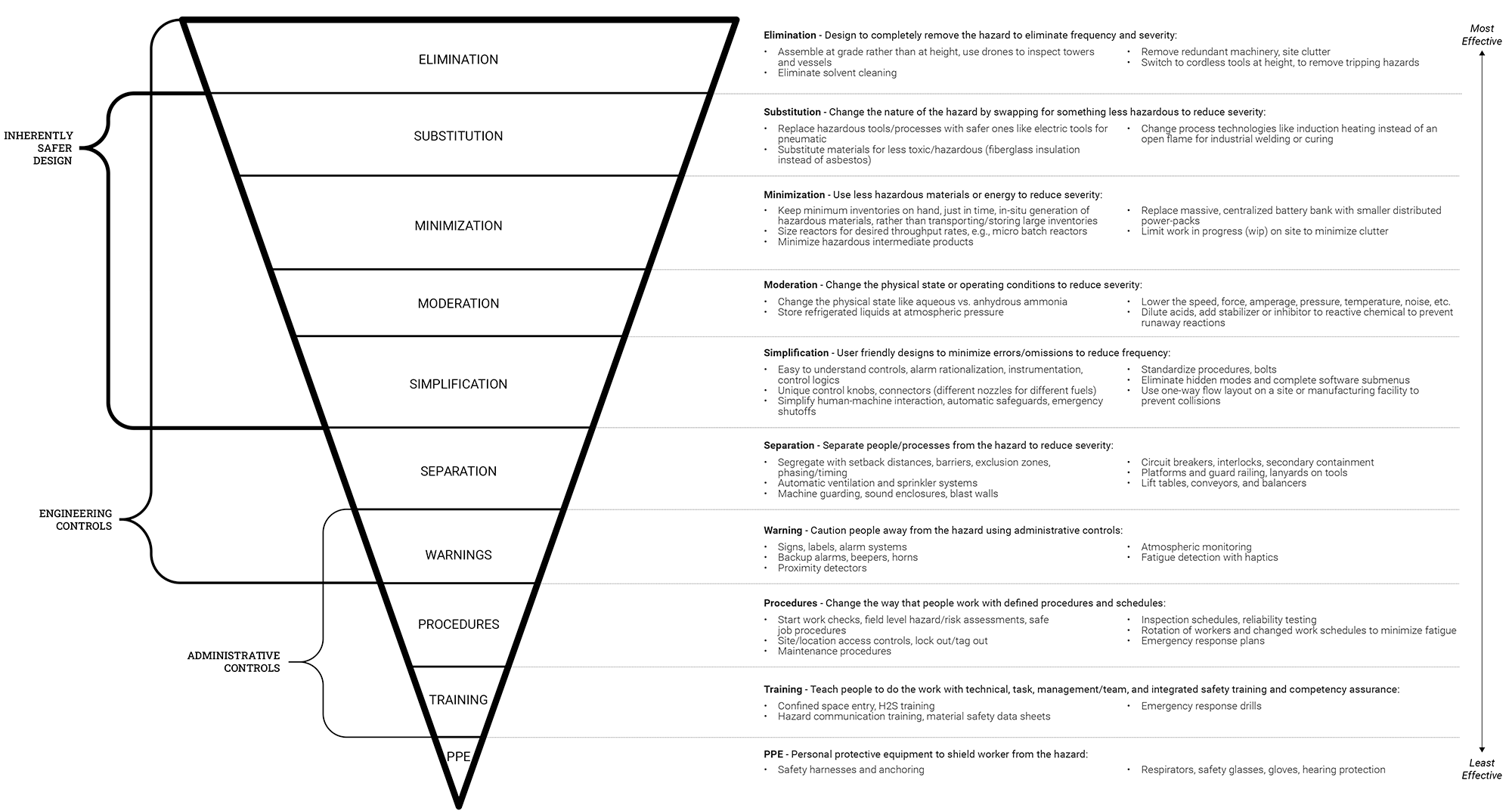
Philosophically, three frameworks apply the hierarchy of control principles in the design phase of a process, project, or product – per the synthesized diagram and examples.
Inherently Safer Design, ISD (Kletz, 1978; Amyotte & Khan, 2021) is used in chemical process safety and nuclear. It argues that “What you don’t have, can’t leak”. It is safest to design hazards out of the system.
Prevention through design, PtD (Gambatese & Hinze, 1996, ANSI/ASSP Z590.3-2021) is used by US NIOSH (National Institute for Occupational Safety and Health, 2007) in
construction, manufacturing, and industry generally. It is a broad umbrella that covers the design of everything from hand tools and heavy machinery and buildings to design out the hazards to workers
Safe (and Sustainable) by design, SSbD (EU NanoReg, 2016) is used in Europe for emerging technologies like software, nanotechnology and bioengineering. It aims to protect workers, consumers, and the environment at the research and development phase. Relying on administrative controls or PPE is considered to be a ‘failure state’.
EXPANDING AND LEVERAGING THE HIERARCHY OF CONTROLS
The hierarchy of controls illustrates the relative efficacy of interventions to eliminate hazards entirely or mitigate the frequency or severity of consequences. Yet, the Brady Review (2020) found that 62% of the highest level of controls put in place following serious mining accidents were administrative controls.
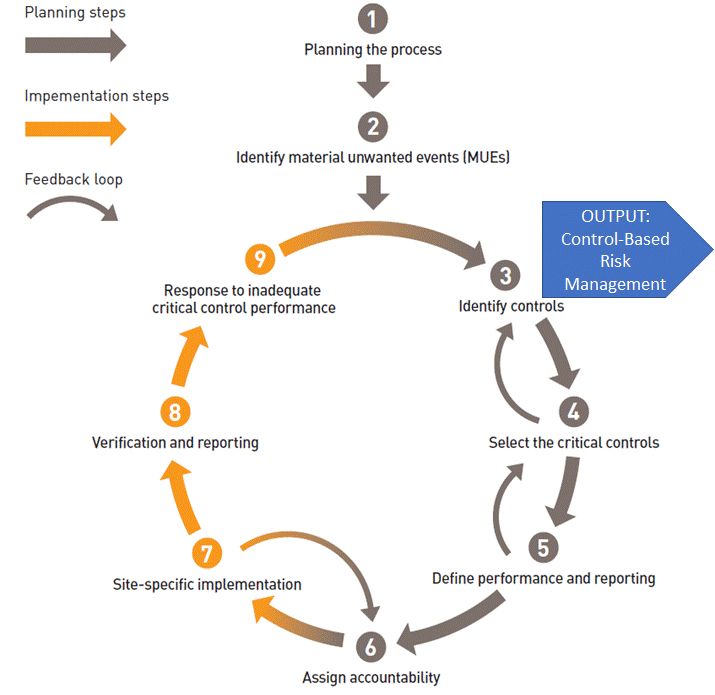
We have worked with 100+ mining operators and contractors and 300+ subject matter experts, to elaborate bowtie diagrams for major incidents/events. From this we identified additional, more effective critical controls (step 3 in ICMM’s critical control management process at right (Joy, 2022)), using this elaborated hierarchy of controls. With this, we can:
- identify more effective critical controls aligned with hazards-tasks,
- build ‘depth of protection’ and resilience into operations, and
- prevent Material Unwanted Events (MUEs) and Major Incident Hazards (MIHs)
DATA THAT WE ANALYZED FOR AN OIL & GAS COMPANY WITH AN IN-HOUSE CUSTOMIZED LLM MODEL (2018-2023)
- > 1K Incident and Critical Controls Assurance Data
- 87.2% Root Cause Identification Accuracy
- 87% New Model-Generated Critical Controls Aligned with Subject Matter Expertise
PROJECT DELIVERABLES
- AI-based multi-label classifier identifying Human Factors Analysis and Classification System (HFACS) root causes from incident narratives
- In-house customized LLM recommendation module generating context-aware CCA gap-fill recommendations with strong semantic alignment with expert-defined engineering controls
- Unified workflow linking incident investigation outputs directly to CCA governance – replacing manual, siloed processes with traceable, automated safety management
- Modular, fine-tunable architecture allowing organizations to substitute the underlying model with proprietary data, addressing AI adoption barriers in regulated high-hazard industries
PRACTICAL IMPLICATIONS
- Moves the conversation upstream. Elevates design and eliminates failure modes before hazards are ‘locked in’.
- Turns the hierarchy of controls into a design-and-diagnosis framework. Adds more resolution with engineering
controls that have the greatest efficacy. - Helps diagnose over-reliance on less effective controls. Reveals when warnings, procedures, training or PPE are
‘carrying the load’. - Bridges occupational safety with process safety/major incident thinking – to create an integrated lens across
people, processes, and high-energy hazards. - Supports safer, more sustainable design – to best protect people, assets, and production.