
VISUALIZING RISK PRECURSORS
ADVANCED ANALYTICS FOR HIGH-CONSEQUENCE INCIDENT PREVENTION
THE CHALLENGE
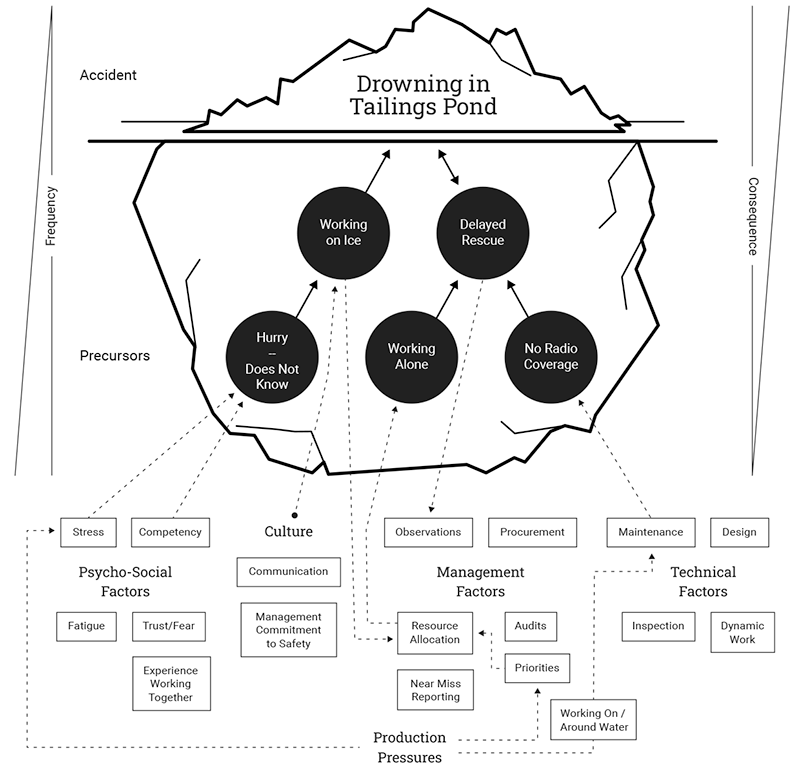
Industry has a great job of reducing higher frequency, lower severity incidents, like total recordable injuries.
However, higher consequence, low frequency failures have more complex and interactive precursors that are more difficult to see.
OUR APPROACH
We have analyzed 100,000’s incidents for mining, electricity generation and
distribution, and construction companies, using our proprietary data analytics. With this, we visualize hidden hazards and
weak signals.
Bayesian Network Analysis help us ‘unravel’ these complex socio-technical system failures:
- in companies’ management system weaknesses and
- determine the relative contribution of precursors,
- to prioritize interventions for the greatest improvements.
IN PRACTICE
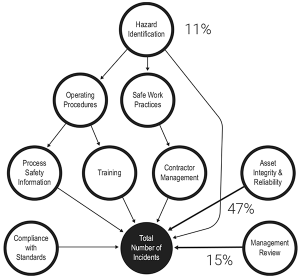
For this company, which had a high proportion of fixed assets, 47% of high-consequence incidents resulted from weakness in asset integrity and reliability, 15% from insufficient management review and continuous improvement, and 11% from insufficient hazard identification.
DATA THAT WE ANALYZED FOR A POWER GENERATION AND DISTRIBUTION COMPANY (2013-2020)
- > 11K: Incident Database
- AI Technique: Bayesian Network for Incident Causation Analysis
- 80%: Incident Linked to Lack of Hazard Identification and Asset Integrity Management
PROJECT DELIVERABLES
- Multi-label text classification extracting technical, human, environmental, and organizational risk factors from
unstructured incident reports to create auditable logic - Multiple Imputation by Chained Equations (MICE) to address missing risk factors in incident records, improving data completeness for network construction to improve data quality
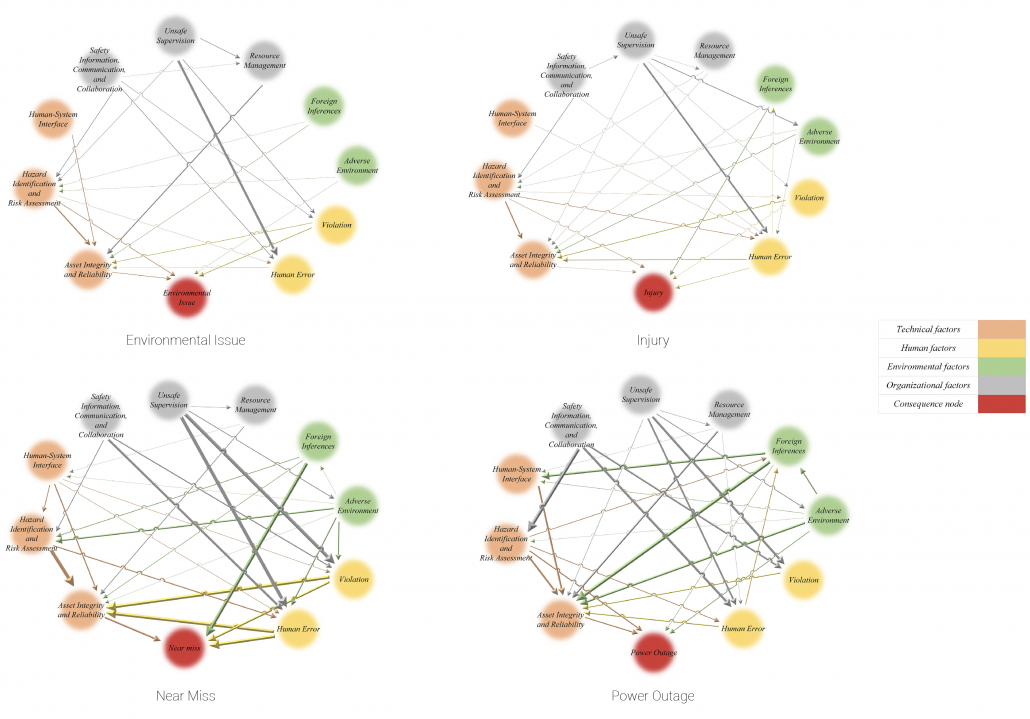
- Four validated Bayesian Network causation structures — one each for power outages, injuries, environmental issues, and near misses — integrating expert knowledge with data-driven structure learning
- Quantified arc-strength analysis revealing probabilistic direct and indirect causal pathways and prioritization
PRACTICAL IMPLICATIONS
- Transforms large volumes of incident data into actionable safety insights, reducing reliance on manual investigation and subjective analysis
- Bayesian network structure quantifies direct and indirect risk pathways (e.g., resource management γ maintenance gaps γ equipment failure), enabling risk-informed maintenance prioritization and budget allocation
- Targeted, evidence-based risk control recommendations per incident type, grounded in probabilistic causal
influence rankings