Decision-Making Frameworks for Policy and Market Uncertainty

Why expect one support approach to fit every decarbonization pathway?

Carbon capture. Methane pyrolysis. Fuel switching. Electrolysis. Electrification. Five pathways, each with its own costs and its own level of maturity. One policy toolkit rarely fits them all.
What’s the problem?

Industrial emitters have several decarbonization pathways that differ in cost and maturity. How viable each one is under different policy and market conditions has not been established. So support that suits one pathway may not suit another, and money and policy effort can land in the wrong place.

How do we solve it?

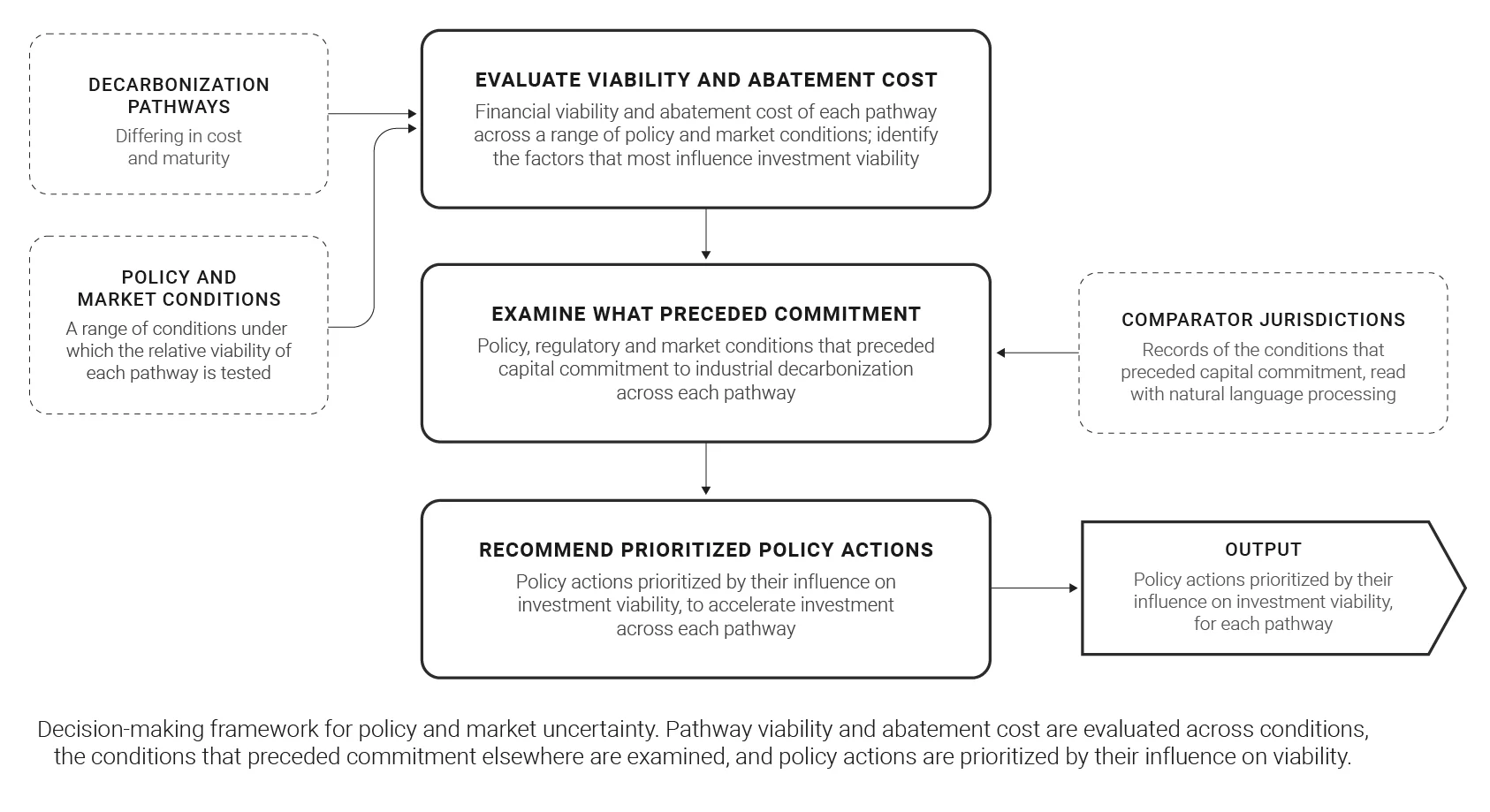
Figure Decision Making Framework

First.

TEST EACH PATHWAY’S FINANCIAL VIABILITY.

Insight Risk Systems evaluates the financial viability and abatement cost of each investment pathway, including Carbon Capture, Utilization and Storage (CCUS), methane pyrolysis, fuel switching, electrolysis and electrification, across a range of policy and market conditions. (‘Abatement cost’ is economist-speak for “what it costs to keep each tonne of emissions out of the air.”) The analysis identifies the factors that most influence investment viability for each pathway.

Second.

LEARN FROM JURISDICTIONS THAT ALREADY MOVED.

Natural language processing examines the policy, regulatory and market conditions that came before real capital commitments to industrial decarbonization in comparator jurisdictions.

Third.

PRIORITIZE THE POLICY ACTIONS.

You get recommended policy actions, ranked by their influence on investment viability, to accelerate investment across each pathway.