Declutter Key Performance Indicators

How many of your metrics actually predict a major incident?

If everything is a priority, nothing is. Consider E. Hunter Harrison at CN. He showed that performance metrics are one of the best ways to create value and integrate operational risk. During his nine years there, profit margins rose from about 0% to 40% and the share price climbed 390%. The right indicators create value. Scattered ones bury it.
What’s the problem?

Most companies have a proliferation of performance metrics that fail to meaningfully predict or prevent major incidents. Worse, misaligned metrics do damage. Hold frontline supervisors accountable for injury rates while giving them no control over competency or turnover, and you get incident suppression and burnout, not safer work.

Meanwhile, only 32% of companies use leading indicators, and just 11% fully use technology to support them.

How do we solve it?

Insight Risk Systems analyzes your operational, maintenance and related data to develop Key Risk Indicators (KRIs).

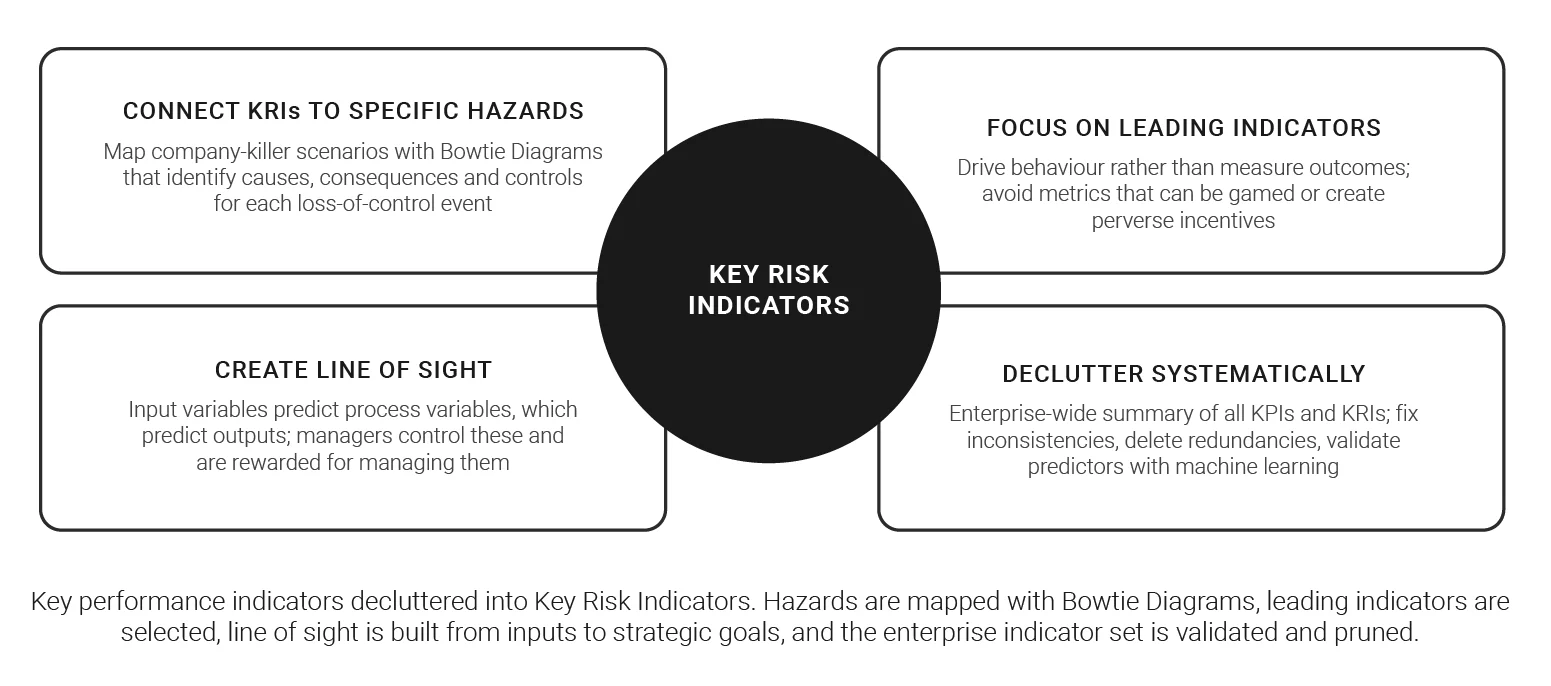
Figure Metric Sprawl To Key Risk Indicators

First.

CONNECT KRIs TO SPECIFIC HAZARDS.

Map your company-killer scenarios (facility explosions, dam failures, data breaches) with bowtie diagrams that show the causes, consequences and controls for each loss-of-control event. And be highly skeptical of the generic safety pyramid: no constant ratio exists between minor and major incidents across companies.

Second.

FOCUS ON LEADING INDICATORS THAT DRIVE BEHAVIOUR.

Measure what people do, not only the outcomes after the fact.

Third.

CREATE LINE OF SIGHT FROM DAILY DECISIONS TO STRATEGIC GOALS.

Input variables should predict process variables, which should predict output variables. Managers should be able to control the indicators they own, and be rewarded for managing them well.

Lastly.

DECLUTTER SYSTEMATICALLY.

Build one enterprise-wide table of every KPI and KRI across your business units. Correct the inconsistencies, delete the redundancies, and use machine learning to test which indicators actually predict incident frequency and consequences.

A GOOD KRI SHOULD:

Be valid and predictivei.e., it moves before the incident does, not after.
Measure what people doi.e., not only what they fail to do.
Offer timely feedbacki.e., often enough that people can still act on it.
Show small improvementsi.e., sensitive enough to reward progress and motivate continuous improvement.
Not be gameablei.e., if you reward fewer reported incidents, expect fewer reports, not fewer incidents.