Integrate Risk Management Efforts Across Diverse Operations and Geographies
Can every part of your system work perfectly, and still cause an incident?
Yes. You can have reliable components in an unsafe system.
Can every part of your system work perfectly, and still cause an incident?
Yes. You can have reliable components in an unsafe system.
In complex systems, incidents can come from dysfunctional interactions between parts that are each working exactly as designed. (‘Dysfunctional interactions’ is systems-speak for “everyone did their job, and it still went wrong.”)
It can be software that runs to specification but never anticipated new operating conditions, like faster data entry. It can be design and operations teams in different places, each unaware of how their decisions interact with the other’s. Each local decision might be ‘correct’ in its own context. Together, they can lead to an accident.
So ‘safety’ is a property of the whole system, not of any one business or functional unit. A systems view lets you see those interactions before they line up.
First.
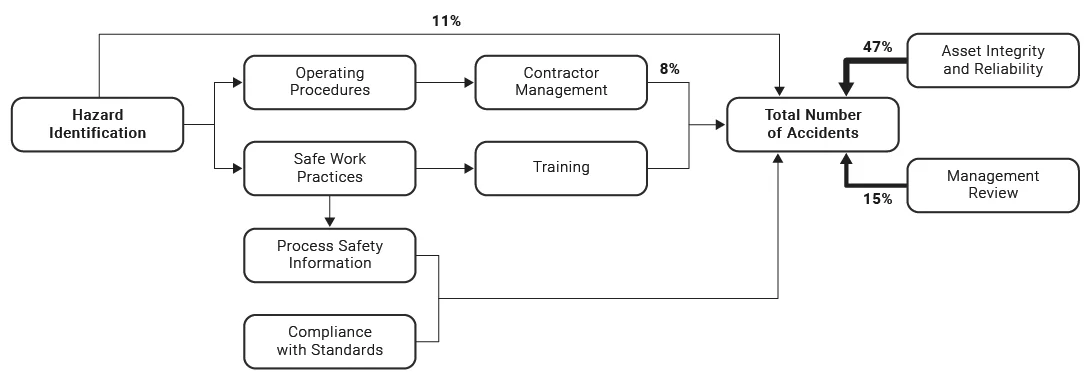
Insight Risk Systems uses machine learning and keyword analysis on your incident reports to find which process safety management elements were most likely involved, directly and indirectly, across all your operations.
Second.
Natural language processing and machine learning on incident reports, survey data and even start-work conversations show the relative influence of human and organizational factors.
Third.
You get practical recommendations to reduce or eliminate those latent causes, with the return on investment defined.
47% of high-consequence incidents came from weakness in asset integrity and reliability, 15% from insufficient management review and continuous improvement, and 11% from insufficient hazard identification. (Visualizing Risk Precursors)
more than 11,000 incident records from 2013 to 2020, modelled as four Bayesian networks (power outages, injuries, environmental issues and near misses). 80% of incidents were linked to a lack of hazard identification and asset integrity management. (Visualizing Risk Precursors)
about 2,800 serious incident and fatality records from January 2016 to June 2025, across four operationally distinct business units. The best of six machine learning models reached 95% accuracy. Common risk drivers: competency gaps, and equipment design and integrity issues. (The Hidden Risk)